
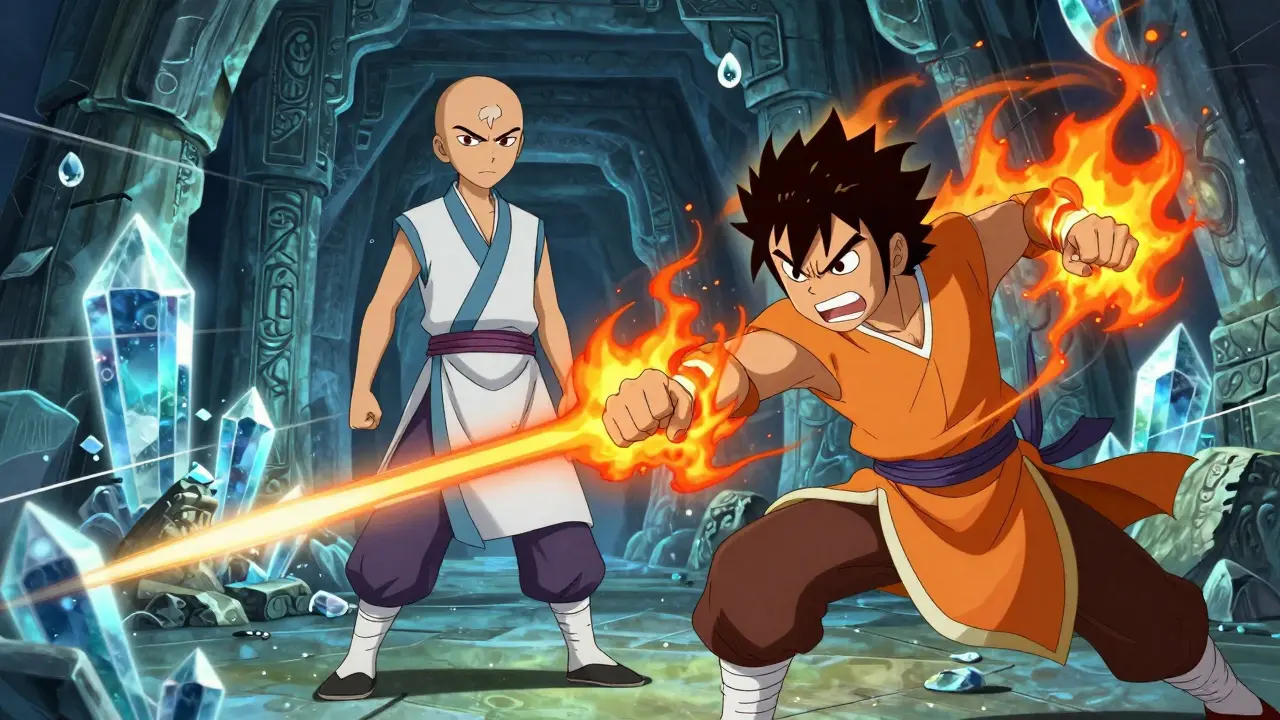
Think about your favorite animated fight scene. Maybe it’s Goku launching a Kamehameha in Dragon Ball Z, or Naruto dodging a barrage of shurikens in a blur of motion. What makes that moment feel real, even though it’s drawn? It’s not just the speed or the sparks. It’s the careful dance between fight choreography and camera work-two hidden pillars that turn pencil lines into heart-pounding drama.
Why Cartoon Fights Feel More Real Than Live-Action
Live-action fights rely on stunt performers, wire rigs, and editing tricks. But in animation, there are no physical limits. A character can twist their body 360 degrees mid-air, stretch limbs like rubber, or explode into a thousand fragments and reform instantly. That freedom is powerful-but also dangerous. Without rules, action becomes chaotic noise. The best animated fights follow the same logic as martial arts: timing, distance, weight. Animators study real boxing, kung fu, and even ballet to understand how bodies move under pressure. In Avatar: The Last Airbender, each bending style has its own rhythm. Earthbending is heavy, grounded, with deliberate stances. Waterbending flows like a wave-smooth, circular, unpredictable. That’s choreography with purpose. And then there’s the camera. In live-action, you’re stuck with what the lens can capture. In animation, the camera can fly through walls, zoom in on a single sweat droplet, or spin around a character as they punch. That’s not just style-it’s storytelling.How Fight Choreography Works in Animation
Animation studios don’t just draw punches. They build sequences like a choreographer builds a dance. Each move has a start, a hit, and a recovery. The animator thinks about momentum: if a character swings a giant hammer, their whole body leans back first. If they’re hit, their body reacts with a delay, then snaps back. That delay? It’s called follow-through and it’s what makes the impact feel heavy. Take the fight between Zuko and Aang in the Crystal Catacombs. Zuko charges in fast, but Aang dodges with minimal motion-just a slight shift of the shoulders. That’s not lazy animation. It’s control. Aang’s calmness contrasts Zuko’s rage. The choreography tells you who’s winning before a single punch lands. Animators often use reference videos. They film actors in martial arts gear, then trace key frames. Some studios, like Studio Ghibli, even hire real swordsmen to perform sequences for reference. In Princess Mononoke, the battle between Ashitaka and the boar god isn’t just violent-it’s balletic. Every slash has weight. Every step has purpose. That’s because the animators understood the rhythm of real combat.The Camera Is a Character
In live-action films, the camera is a tool. In animation, it’s a character. It breathes, it panics, it gets excited. When the action heats up, the camera doesn’t just follow-it participates. In The Incredibles, the scene where Mr. Incredible fights the Omnidroid in the city uses camera movement like a heartbeat. The camera zooms in tight on his face as he grits his teeth. Then it whips sideways as he’s thrown through a billboard. Later, it spins 180 degrees as he flips mid-air to land a punch. That’s not random. It’s emotional pacing. The camera mirrors his exhaustion, then his surge of energy. Some scenes use forced perspective-making a character look tiny against a collapsing building to show how outmatched they are. Others use Dutch angles-tilted frames-to make the viewer feel off-balance during a chaotic brawl. These aren’t just tricks. They’re tools to control how the audience feels. In Samurai Jack, the camera often freezes for a full second after a strike. No sound. No motion. Just silence. That pause makes the next hit hit harder. It’s the same technique used in John Wick-but here, it’s drawn. The power comes from control, not chaos.
Sound and Motion Are a Team
You can’t talk about fight choreography without sound. In animation, sound design isn’t added after the fact-it’s part of the animation process. Animators often work with sound designers from day one. The crunch of a bone, the whoosh of a blade, the thud of a body hitting stone-each sound is timed to a specific frame. In Batman: The Animated Series, every punch has a distinct sound that matches the force. A light jab? A quick thwip. A heavy uppercut? A deep, echoing BOOM with reverb. That’s not random. It’s physics made audible. Some studios even use impact frames-extra drawings that appear for just one or two frames to show the shock of a hit. In Avatar: The Last Airbender, when Aang blocks a fireball, the air around his palm ripples with six extra frames of distortion. That’s six frames of pure visual sound. You don’t hear the air exploding-you feel it.What Makes a Fight Scene Memorable?
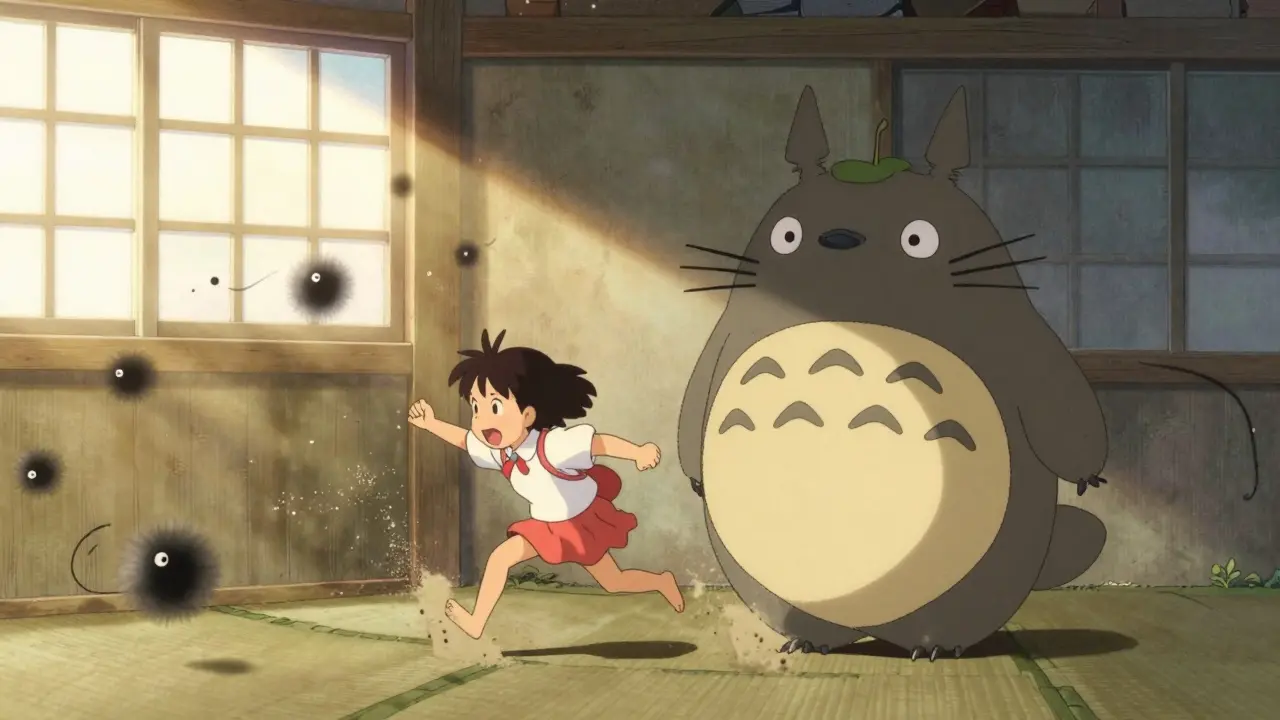
Not every animated fight needs to be epic. Sometimes, the most powerful ones are quiet. In My Neighbor Totoro, there’s no real combat. But when Satsuki and Mei chase the soot sprites through the house, the choreography is pure joy. Their movements are clumsy, energetic, full of missteps. The camera stays low, like a child’s eye level. The lighting is soft. The sound is giggles and rustling fabric. It’s not a fight-but it’s still choreographed. It tells you who these girls are. Memorable animated fights have three things:- Clear stakes-you know why the characters are fighting
- Distinct styles-each fighter moves differently
- Emotional payoff-the fight changes something inside them
Modern Trends in Animated Action
Today’s studios blend styles like never before. Spider-Verse mixed comic book panels with anime-style speed lines. Arcane used live-action motion capture for realistic body movement, then painted it in a stylized, painterly world. The result? A fight scene that feels both grounded and surreal. AI tools now help animators generate rough motion paths, but the soul of the scene still comes from human artists. The best studios still use hand-drawn keyframes for emotional moments. Why? Because a computer can’t feel the weight of a character’s grief-or the joy of a perfect dodge. The rise of streaming has also changed pacing. With longer episodes, fights can breathe. In Avatar: The Legend of Korra, a single battle lasts over ten minutes. It’s not just action-it’s a slow-burn emotional arc. The camera lingers on faces. The choreography builds tension like a symphony.What You Can Learn from Animated Fights
You don’t need to be an animator to appreciate this. Think about how you tell stories. Whether you’re writing, filming, or even just describing something to a friend-you’re choreographing motion. Want to make your scenes more vivid? Try this:- Map out the emotional arc of the fight. Who’s winning? Who’s losing? When does it flip?
- Give each character a movement signature. Are they fast and erratic? Slow and deliberate?
- Use the camera as a mood tool. Zoom in for intimacy. Pull back for isolation.
- Add silence. Sometimes the most powerful moment is the one after the punch.
Why do animated fights look more exaggerated than real ones?
Animated fights exaggerate motion because they’re not bound by physics or human limits. A character can spin ten times before landing or stretch their arm to hit someone across the room. This exaggeration isn’t just for fun-it helps communicate speed, power, and emotion more clearly. A real punch might take half a second. In animation, it’s stretched to two seconds with motion lines and impact frames so the audience feels every bit of force.
How do animators plan fight scenes before drawing them?
Animators start with a storyboard, sketching out each key moment like a comic strip. Then they create an animatic-a rough version with timing and sound. They often use reference footage of real fighters or dancers to get the rhythm right. Some studios hire choreographers to block out the fight like a stage play. Only after all that do they begin the actual animation, frame by frame.
Do all animated fight scenes use the same style?
No. Each studio and director has their own visual language. Studio Ghibli favors soft, flowing motion with natural weight. Toei Animation leans into fast, flashy moves with lots of speed lines. Western studios like Cartoon Network often use squash-and-stretch for comedic effect. Even within one show, styles can shift-like in Avatar: The Last Airbender, where bending styles match real martial arts traditions.
Can animated fights be emotionally powerful without dialogue?
Absolutely. In fact, some of the most moving fights have no words at all. In My Neighbor Totoro, the chase scene between the girls and the soot sprites is pure joy. In WALL-E, the dance between WALL-E and EVE says more than any line could. Emotion comes from timing, body language, and how the camera holds on a face after a blow. Silence and motion together build deeper connection than shouting ever could.
What’s the biggest mistake animators make in fight scenes?
The biggest mistake is making everything too fast. If every frame is a blur, the audience can’t follow what’s happening. Great fight scenes have rhythm-moments of speed, then stillness. They give the viewer time to breathe, to feel the tension, to understand the stakes. Chaos without clarity isn’t exciting-it’s exhausting.
Animated action isn’t just about spectacle. It’s about making the invisible visible-the weight of a punch, the fear in a glance, the quiet after the explosion. When choreography and camera work align, a cartoon doesn’t just move. It breathes.