
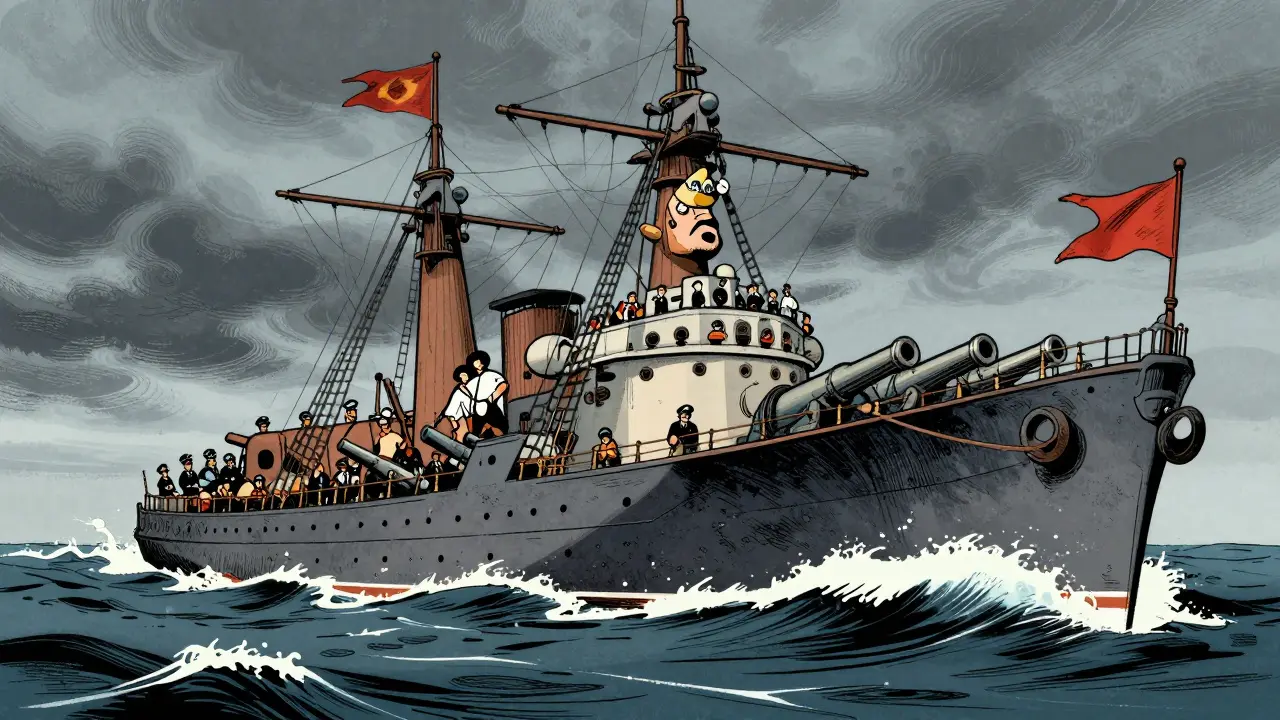
Imagine watching a film where the cuts alone make your heart race faster than any explosion ever could. That is the power of editing, and few movies demonstrate it better than the Battleship Potemkin. Released in 1925, this silent masterpiece did not just tell a story; it invented a new language for visual storytelling. Even a century later, directors study its frames to understand how to manipulate emotion through rhythm and timing. It is not merely a historical artifact but a living blueprint for modern filmmaking.
The Historical Context of Soviet Cinema
To understand why this film matters, you first need to grasp the world it came from. The film was produced in the Soviet Union shortly after the Russian Revolution. The government was looking for ways to spread communist ideals to a largely illiterate population. Cinema was chosen as the primary tool because images speak louder than words. Sergei Eisenstein was tasked with creating a propaganda piece about the 1905 mutiny on the Russian warship Potemkin.
Battleship Potemkin is a 1925 Soviet silent propaganda film directed by Sergei Eisenstein. Also known as Potemkin, it was released in 1925 and has since become a cornerstone of film history. The film's narrative focuses on a mutiny by sailors against their officers and the subsequent uprising in the city of Odessa.While many films of that era were simply stage plays recorded on camera, Eisenstein wanted to do something different. He believed that the collision of two shots could create a new meaning in the viewer's mind. This was a radical idea at the time. Most filmmakers thought the camera should just observe the action passively. Eisenstein argued that the editor's room was where the real magic happened. This shift in perspective changed how movies were made forever.
Understanding Soviet Montage Theory
The core innovation of the film lies in a technique called Soviet Montage Theory. This concept suggests that the meaning of a scene is not found within a single shot but in the relationship between consecutive shots. Think of it like a mathematical equation. Shot A plus Shot B equals a new idea C that neither shot contained on its own. This was heavily influenced by the earlier work of Lev Kuleshov, who discovered that audiences project emotions onto a neutral face depending on what image follows it.
Eisenstein took this psychological trick and weaponized it for political and emotional impact. He did not want the audience to just watch; he wanted them to feel the tension physically. By cutting quickly between contrasting images, he created a rhythm that mimics a heartbeat or a drumbeat. This method stands in stark contrast to the continuity editing used in Hollywood, which tries to make the editing invisible. Eisenstein made the editing visible and felt.
The Odessa Steps Sequence Breakdown
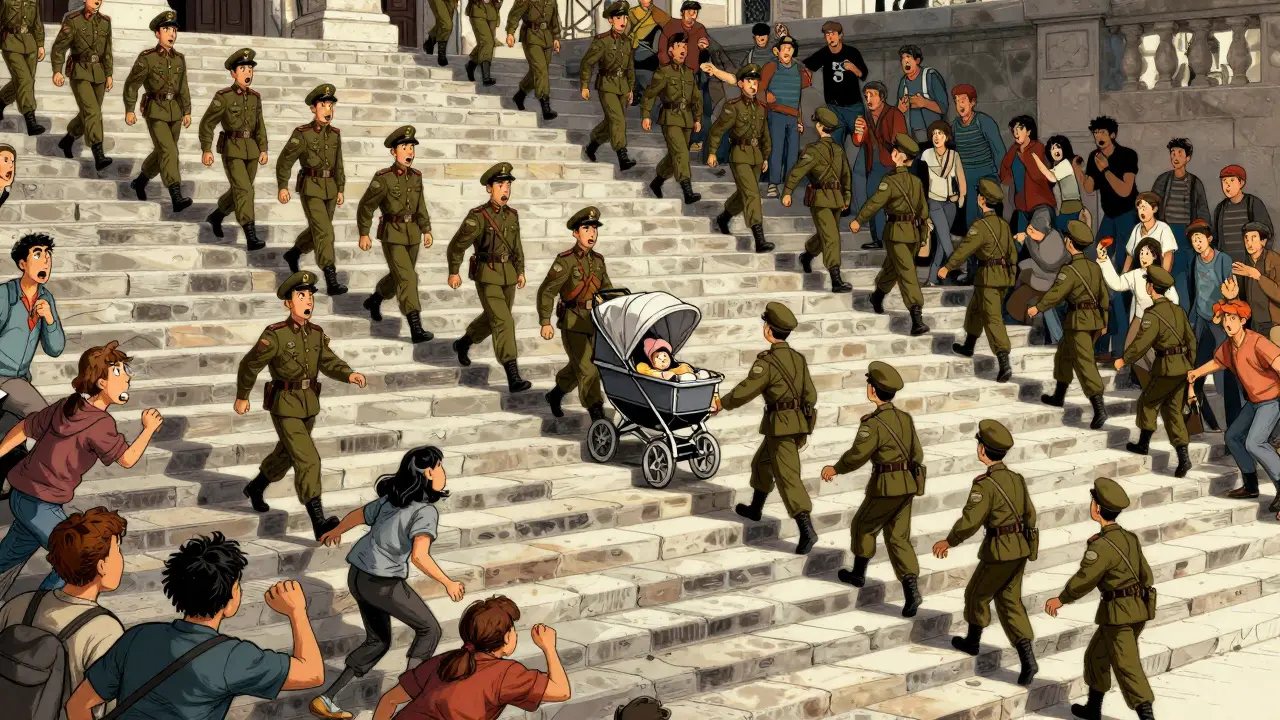
If you only watch one scene from the entire film, it should be the Odessa Steps sequence. This segment depicts a massacre of civilians by soldiers and is often cited as the greatest sequence in cinema history. The sequence is famous for its manipulation of time. In reality, the steps are short, and the massacre would have taken minutes. In the film, it feels like an eternity.
Eisenstein achieves this by repeating actions and using slow motion. He shows the soldiers marching down the steps from multiple angles. He cuts back to the terrified crowd repeatedly. The camera lingers on individual victims, like the mother with the baby carriage. When the carriage rolls down the steps, it is a moment of pure visual storytelling. No dialogue is needed to convey the horror. The editing creates a sense of chaos and helplessness that is still effective today.
| Technique | Purpose | Effect on Viewer |
|---|---|---|
| Jump Cuts | Disrupt flow to create tension | Anxiety and unease |
| Low Angles | Make soldiers look imposing | Feeling of powerlessness |
| Repetition | Extend the duration of events | Prolonged suspense |
| Close-ups | Focus on emotional reactions | Empathy for victims |
The use of the baby carriage is particularly iconic. It represents innocence caught in a political storm. The wheels breaking as it tumbles down the stairs symbolize the collapse of social order. Every frame serves a purpose. There is no wasted footage. This economy of storytelling is a lesson that modern directors still try to master.
Technical Innovations and Camera Work
Beyond editing, the camera work was revolutionary. Eisenstein used dynamic camera movements that were rare for the silent era. He placed the camera at low angles to make the soldiers look like giant machines. This dehumanized the oppressors. Conversely, he shot the crowd from high angles to show their vulnerability. These choices were not accidental; they were calculated to guide the audience's sympathy.
The film also utilized lighting and composition to create depth. Even without color, the contrast between light and shadow added drama. The white uniforms of the soldiers against the dark steps created a stark visual division. This visual clarity ensured that the message was understood by anyone, regardless of language barriers. This universal quality is why the film remains accessible to international audiences today.
Legacy and Influence on Modern Cinema
The impact of this film extends far beyond the 1920s. Almost every major director has cited it as an influence. Alfred Hitchcock, known for his mastery of suspense, studied the Odessa Steps sequence closely. You can see the DNA of this film in the shower scene from Psycho. The rapid cutting and the focus on body parts rather than full faces are direct descendants of Eisenstein's style.
Even modern action films rely on the principles established here. Think about the fast-paced editing in movies like Mad Max: Fury Road or the opening sequence of Saving Private Ryan. The goal is the same: to immerse the viewer in the chaos of the moment. Quentin Tarantino has also referenced the film when discussing how he structures his own violent scenes. The idea that violence can be stylized and rhythmic rather than just graphic comes from this era.
Furthermore, the film influenced the development of propaganda and political filmmaking. It showed how cinema could be used to mobilize masses. While the intent was political, the artistic merit transcended the message. It proved that a film could be both a tool for ideology and a work of high art. This dual nature is still debated in film studies today.
Why It Still Matters in 2026
You might wonder why a silent black-and-white film matters in an age of 4K digital streaming and CGI. The answer lies in the fundamentals. No matter how much technology advances, the way humans process visual information does not change. We still react to rhythm, contrast, and pacing in the same way our grandparents did. Understanding these basics is crucial for anyone who wants to create compelling visual content.
In the current landscape of short-form video content, the principles of montage are more relevant than ever. TikTok and Reels rely on quick cuts to maintain attention. Eisenstein understood that attention is a finite resource. He knew he had to grab the viewer and hold them through editing. This is the same challenge facing creators today. The medium has changed, but the psychology remains the same.
Additionally, the film serves as a reminder of the power of storytelling. In a world often dominated by spectacle, Potemkin shows that emotion comes from structure. It teaches us that how you tell a story is just as important as the story itself. For students of film, it is a masterclass in economy and precision. There is no room for filler. Every second counts.
Is Battleship Potemkin available to watch today?
Yes, the film is in the public domain and can be found on various streaming platforms, DVD releases, and free archives like the Internet Archive. Several restored versions exist with different musical scores.
How long is the film?
The runtime varies depending on the version, but it typically runs between 75 to 83 minutes. The original silent version is shorter than some later sound-restored editions.
Was the film banned in any countries?
Yes, it was banned in the United Kingdom and France shortly after release due to fears it would incite revolution. It was also banned in Germany for a period due to its political content.
What is the most famous scene in the movie?
The Odessa Steps sequence is the most famous. It depicts the massacre of civilians and is widely studied for its innovative editing techniques and emotional impact.
Who directed the film?
The film was directed by Sergei Eisenstein, a pioneering Soviet filmmaker known for developing the theory of montage.
Watching this film is not just an exercise in history. It is a lesson in the power of the medium itself. It challenges you to see how images can be constructed to create meaning. Whether you are a filmmaker, a student, or just a movie lover, there is something to be gained from experiencing this revolutionary work. It stands as a testament to the idea that cinema is not just entertainment, but a force that can shape how we see the world.