
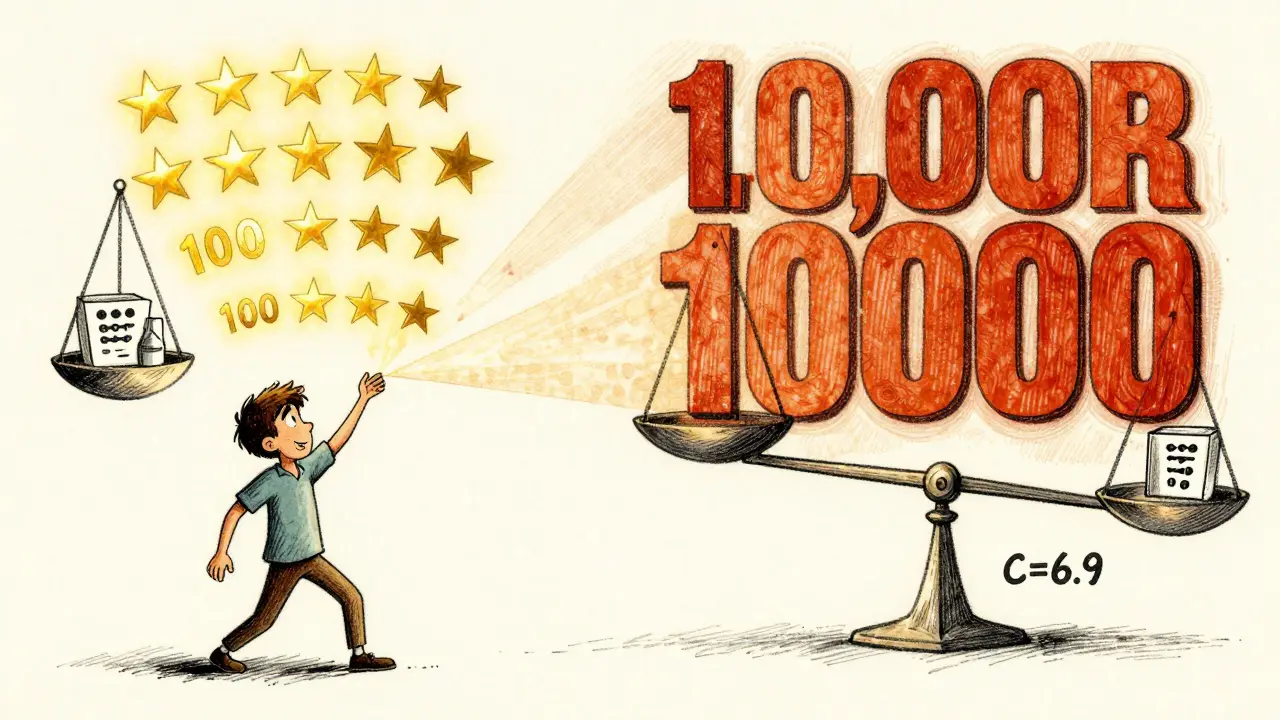
Ever wonder why a movie with 10,000 five-star ratings still has a 7.8 on IMDb, while a smaller film with 500 perfect scores sits at 9.1? It’s not a glitch. It’s math. IMDb doesn’t just average ratings. It uses a secret formula called the weighted rating to keep scores honest. This isn’t just about popularity-it’s about reliability. And if you’ve ever argued about whether a movie deserves its score, you’re already in the middle of this system.
What’s the problem with simple averages?
Imagine two movies:
- Movie A: 100 users, all give it a 10. Average = 10.0
- Movie B: 10,000 users, average score = 9.5
If you just took raw averages, Movie A would be #1. But that’s misleading. Movie A only had 100 votes. Maybe it was a niche indie film loved by a small group of fans. Movie B? That’s a blockbuster with millions of viewers. A 9.5 from 10,000 people tells you something very different than 10.0 from 100.
Without weighting, IMDb’s ratings would be easy to game. A fan club could flood a low-budget film with 10s and push it above Oscar winners. The system needs to balance how good people think a movie is with how many people think it.
The formula: not as scary as it looks
IMDb’s weighted rating (WR) uses this equation:
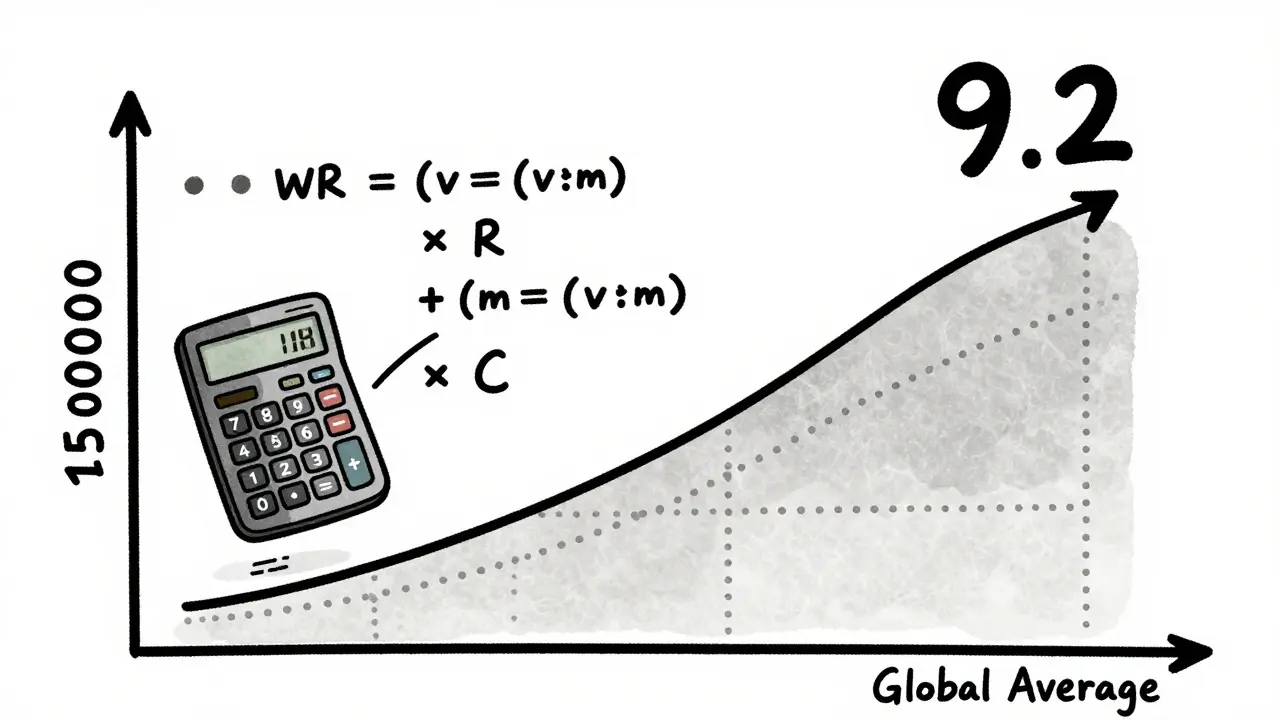
WR = (v ÷ (v + m)) × R + (m ÷ (v + m)) × C
Let’s break it down into plain terms:
- v = number of votes for the movie
- R = average rating of the movie (from 1 to 10)
- m = minimum votes required to be listed in the top ratings (this is fixed at 25,000)
- C = the mean vote across all movies on IMDb (currently around 6.9)
So here’s what’s happening:
- If a movie has fewer than 25,000 votes, its score gets pulled toward the overall average (C). The fewer votes it has, the more it gets pulled.
- If a movie has more than 25,000 votes, its own average (R) dominates the score. It’s trusted.
- That 25,000 threshold isn’t random. It’s based on years of data showing when a rating becomes statistically stable.
Example: A movie with 15,000 votes and a 9.2 average.
- v = 15,000
- R = 9.2
- m = 25,000
- C = 6.9
WR = (15,000 ÷ (15,000 + 25,000)) × 9.2 + (25,000 ÷ (15,000 + 25,000)) × 6.9
WR = (0.375 × 9.2) + (0.625 × 6.9)
WR = 3.45 + 4.31 = 7.76
So even though users gave it a 9.2, its official score is 7.76 because it hasn’t reached the threshold of trust. Once it hits 25,000 votes, it’ll start climbing toward 9.2.
Why does this matter for viewers?
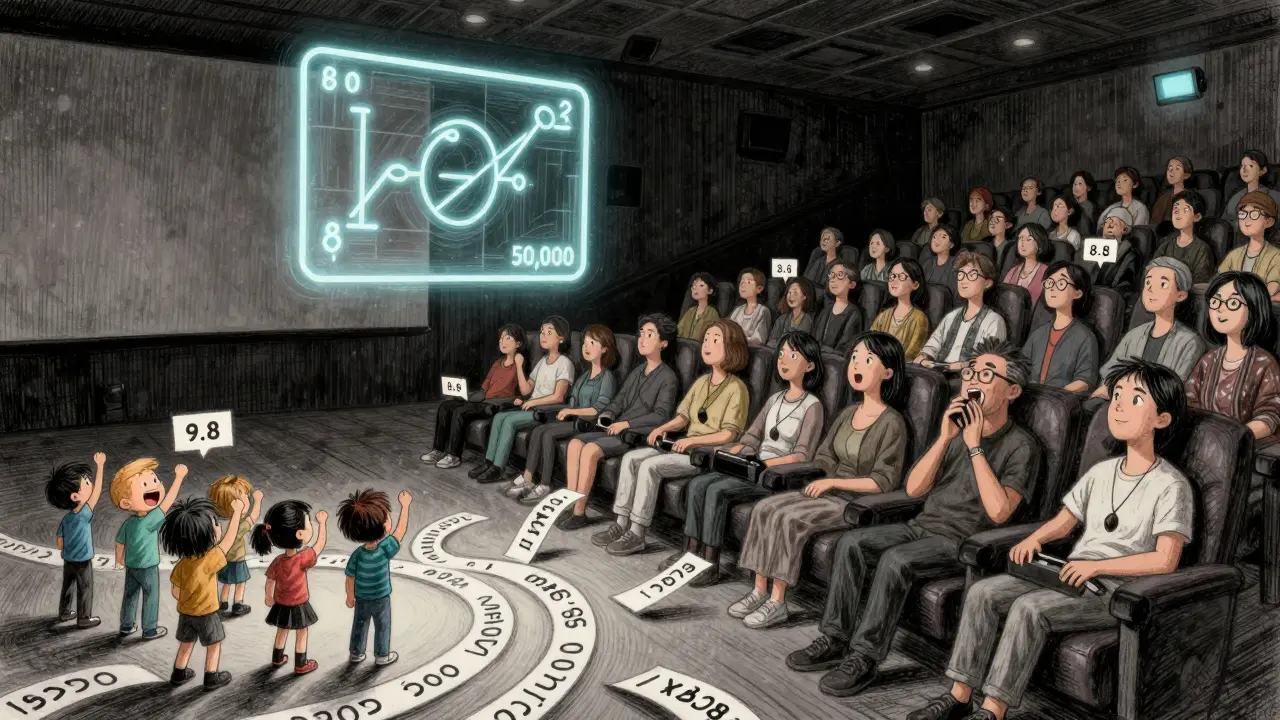
This system stops fake hype. You’ve seen it: a movie with 100,000 votes and a 7.0 rating. It’s not a cult hit-it’s just average. But if a film with 50,000 votes has an 8.8, you can trust that. The math says enough people have weighed in.
It also helps you spot outliers. A film with 300 votes and a 9.8? That’s probably not real. Maybe it’s a studio campaign or a botnet. IMDb’s formula shrinks that score toward 6.9. You’ll see it drop to maybe 7.3. That’s the system working.
Conversely, a movie with 50,000 votes and a 6.5? That’s not a flop. It’s a solid, widely seen film that people liked moderately. It’s not being dragged down by the average-it’s being anchored by it.
What’s the global average? And why does it change?
The value of C (the overall mean) isn’t fixed. It updates daily based on all ratings across IMDb’s database. Right now, it’s 6.9. A few years ago, it was 6.7. A decade ago, it was 6.4.
Why? Because people’s tastes shift. More comedies get rated now. More international films. More streaming originals. The average moves slowly, but it moves. That means a 7.5 today isn’t the same as a 7.5 in 2018. The scale is relative.
This also explains why some older classics seem to have dropped. The Godfather had a 9.2 in 2010. Now it’s 8.9. Not because people like it less. Because the global average rose. More people are rating movies now, and more of them are giving 7s and 8s. So the scale shifted.
How does this affect movie makers?
For studios, this formula is both a shield and a sword.
- Shield: If a film is a sleeper hit with steady ratings over months, the formula lets it climb. It doesn’t get crushed by early, biased votes.
- Sword: If a studio tries to manipulate ratings-say, by paying fans to flood a movie with 10s-the system detects it. The score won’t spike. It’ll hover near 6.9 until real, organic votes roll in.
Independent filmmakers benefit most. A low-budget film doesn’t need a million views to be trusted. Just 25,000 real, thoughtful ratings. That’s why indie darlings like Parasite or Minari can rise to 8.0+ without studio hype.
What about user bias?
IMDb’s system doesn’t fix everything. It still suffers from:
- Over-rating by fans of a genre (horror fans give 9s to every zombie movie)
- Under-rating by people who hate a director’s style
- Vote brigading during awards season
But the weighted formula reduces these swings. A horror movie with 50,000 votes and a 7.8? That’s a good score. A romance with 30,000 votes and a 6.2? That’s a quiet, respected film. The system doesn’t care if you love or hate superhero movies-it cares how many people have seen it and what they think.
That’s why you’ll see a 7.0 on a movie you loved. It’s not wrong. It’s balanced.
How to read IMDb ratings like a pro
Here’s how to use the system, not just accept it:
- Check the vote count. If it’s under 10,000, treat the score as a hint, not a verdict.
- Look at the trend. Has the score been rising over weeks? That’s organic interest.
- Compare similar films. A 7.5 on a sci-fi epic means something different than a 7.5 on a rom-com.
- Don’t ignore the 7s. A 7.0 on a 25,000-vote movie is often a sign of quiet excellence.
- Watch for the 9s. A 9.0+ with over 50,000 votes? That’s rare. That’s a cultural moment.
IMDb’s formula doesn’t tell you what to watch. It tells you what’s been thoughtfully watched.
What’s next for IMDb ratings?
There’s talk of tweaking the formula. Some suggest lowering m from 25,000 to 10,000. Others want to factor in vote quality-like whether the voter has watched 50+ films on IMDb or just one.
But the core idea stays: ratings need context. A number without a crowd is noise. A number with a crowd is a signal.
Next time you see a movie with a 7.6, don’t just shrug. Ask: How many people voted? And how much does their voice count? That’s the real score behind the score.
Why does my favorite movie have a lower score than I expected?
IMDb’s weighted rating pulls scores toward the global average (C) if the movie doesn’t have enough votes (under 25,000). Even if you and your friends gave it a 10, if only 5,000 people rated it, the system reduces its score to reflect uncertainty. Once it hits 25,000 votes, it’ll rise closer to your actual average.
Can a movie’s rating be manipulated?
It’s hard. IMDb’s formula is designed to resist vote manipulation. If a studio tries to flood a movie with fake 10s, the score won’t spike unless it hits 25,000 real, unique votes. Even then, the weighted formula pulls it toward the true average. Most fake campaigns fail because they can’t generate enough organic, sustained votes.
Why do older movies seem to have dropped in rating?
The global average (C) has slowly risen over time-from 6.4 a decade ago to 6.9 today. As more people rate movies, and as tastes shift toward higher ratings, the baseline moves. A 9.2 in 2010 might be an 8.9 now, not because people like it less, but because the overall scale has changed. The formula adjusts to reflect the new norm.
Does IMDb filter out fake votes?
Yes. IMDb uses automated systems to detect patterns of abuse-like multiple votes from the same IP, or accounts created just to rate one movie. Suspicious votes are removed before the weighted formula even applies. The formula then adds another layer of protection by requiring a high vote count to trust a score.
Is IMDb’s formula used by other sites?
Some, yes. Rotten Tomatoes uses a different system (critic vs. audience scores). Letterboxd doesn’t use a weighted formula-it shows raw averages. But platforms like Netflix and Amazon Prime Video use similar weighted models to avoid letting small groups skew recommendations. IMDb’s approach is one of the most transparent and widely studied.