
Blockchain Trilemma: Understanding Scalability, Security, and Decentralization
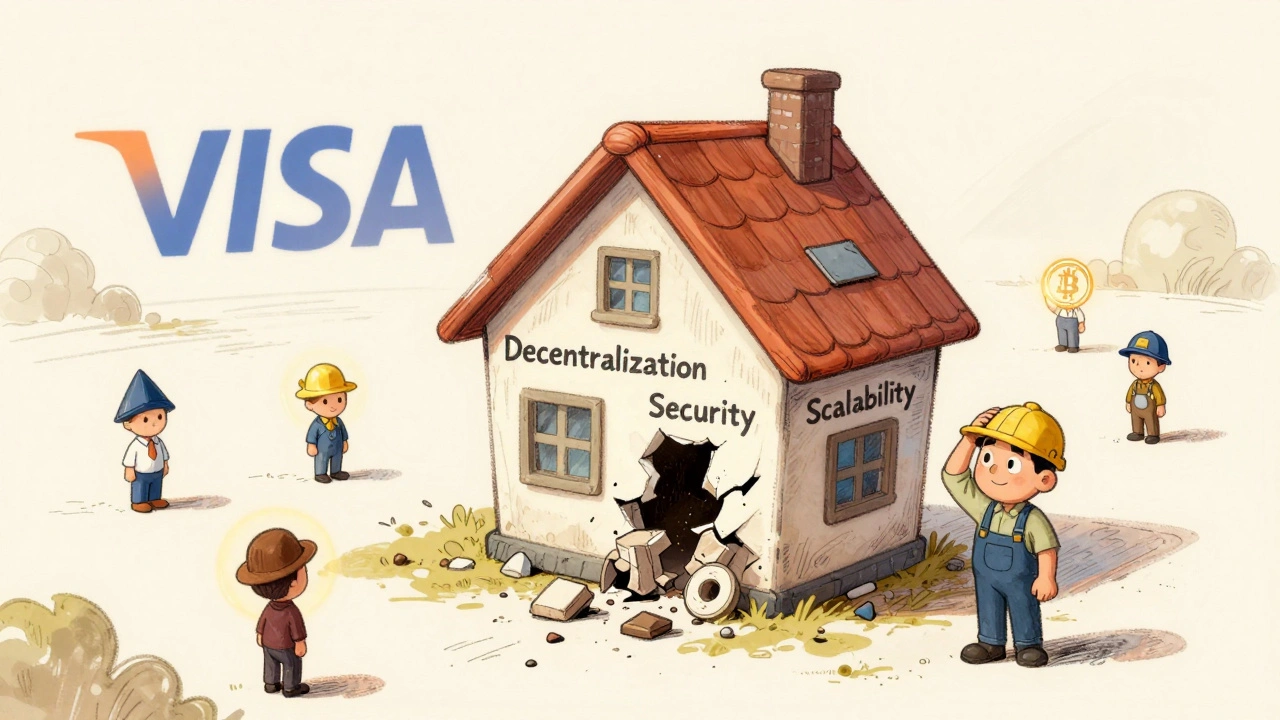
When you hear people talk about blockchain trilemma, the fundamental challenge of balancing three core properties in any blockchain system: scalability, security, and decentralization. Also known as the crypto triangle, it’s the reason why no single blockchain has yet cracked the code of being fast, safe, and open to everyone at the same time. Think of it like trying to build a house that’s cheap, earthquake-proof, and made entirely by volunteers—each improvement in one area usually weakens another.
The scalability, how many transactions a network can handle per second is what makes or breaks real-world use. Bitcoin can do about 7 transactions a second. Ethereum used to be around 15. Compare that to Visa, which handles 24,000. That’s why some chains try to scale by cutting down the number of nodes validating each transaction—risking decentralization, how widely control is spread among users and miners. The more nodes you need, the slower it gets. The fewer nodes, the easier it is for a few powerful players to take over.
Then there’s security, the system’s resistance to attacks, fraud, and tampering. Proof-of-work blockchains like Bitcoin are tough to hack because they require massive computing power. But that same power eats up electricity and slows things down. Newer chains use proof-of-stake to save energy and speed things up, but that opens up new risks—like what happens if a few big wallets control most of the stake? It’s not just theory. Real attacks on smaller chains happen every year.
There’s no magic fix. Every solution you see—Layer 2s, sharding, zk-Rollups—is just a trade-off in disguise. Some prioritize speed over openness. Others lock in security but limit who can run nodes. The best projects don’t pretend they’ve solved the trilemma. They admit it, then pick the right balance for their users. That’s why you see Bitcoin stay slow and safe, Solana push for speed with a more centralized validator set, and Ethereum slowly trying to do both.
If you’ve ever wondered why your favorite crypto app feels slow during peak hours, or why some coins seem too centralized to trust, the answer is usually hiding in this three-way tug-of-war. The posts below dig into real-world examples: how streaming services deal with similar bottlenecks, how power outages break digital systems, and why privacy tools often sacrifice convenience. You’ll see how the same pressures that shape blockchain networks also show up in your Netflix buffer, your Wi-Fi drop, and your kid’s tablet settings. It’s not just crypto—it’s how systems work when they’re pushed to their limits.
Blockchain Scalability: Understanding the Trilemma and Its Real-World Impact
The blockchain trilemma explains why no network can be fully decentralized, secure, and scalable at the same time. Learn how Bitcoin, Ethereum, and Solana make trade-offs - and what it means for users and developers.